Tower Dash Crash Game

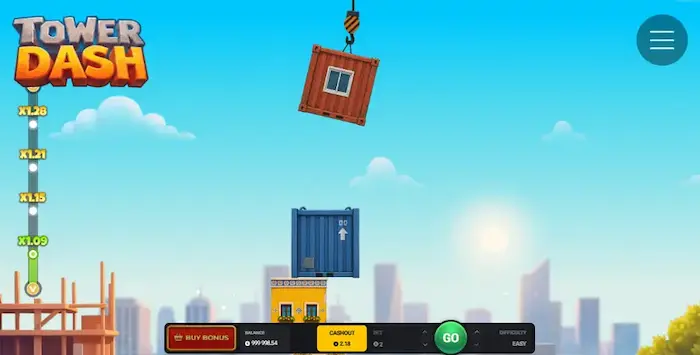
Tower Dash is a step-based crash game built around a tower-stacking mechanic rather than reels or symbols. Players choose a risk level, add floors, and cash out before the round collapses.
| Attribute | Details |
|---|---|
| Release year | 2026 |
| Game type | Crash / step-based instant-win |
| Provider | Astriona Games |
| RTP | 98% |
| House edge | 2% |
| Min stake | €1 |
| Max stake | €200 |
| Maximum multiplier / max win | Not confirmed consistently across sources |
| Provably fair status | Yes, verifiable |
| Theme | Construction / tower building |
Round structure
Each round starts with a bet and a selected risk level, then the tower climbs floor by floor. The active multiplier rises with every successful step, and the round ends either when the player cashes out or when the tower collapses. The mechanic is built for quick decisions, so timing matters more than waiting for a long sequence to develop.
The game uses a crash-style format, so there are no reels, paylines, or symbol combinations to track. Instead, the player is dealing with a rising payout curve and a fixed collapse point determined before the round resolves. That makes Tower Dash a pure timing and bankroll game rather than a traditional slot release.
Risk settings
Tower Dash offers multiple risk levels, which change how aggressively the multiplier builds and how often the tower tends to fail early. Lower risk settings favour shorter climbs and more frequent exits, while higher settings push for bigger payouts with a sharper chance of loss. That structure gives the game a clear high-volatility profile.
| Risk level | Round behaviour | Payout ceiling |
|---|---|---|
| Low | More frequent exits, smaller rises | Lower but steadier |
| Medium | Balanced pace and risk | Middle-range growth |
| High | Faster swings, earlier collapses | Highest potential |
The key point is simple: the risk setting changes distribution, not the basic rules. A higher setting does not improve long-term return, it only shifts where the variance lands. Players who prefer controlled sessions usually stay in the lower tiers.
Tower Dash cash-out mechanics
The cash-out system is the core of the game. Players can lock in the current multiplier manually before the tower falls, or use an automatic cash-out threshold if the operator’s version supports it. If no cash-out happens before collapse, the round ends and the stake is lost.
- Manual cash-out that locks in the current multiplier.
- Auto cash-out support on some versions.
- Provably fair round verification.
- Adjustable risk levels before each round.
- Fast round resolution with no reel spin cycle.
The game’s appeal comes from that simple risk decision. Stay in too long and the round resets to zero; leave too early and the payout stays modest. That tension is what gives Tower Dash its pace.
Maximum win ceiling
The exact top payout is not consistent across all listings, so it should be checked in the in-game rules before play. Some operators may also apply their own payout caps, especially on higher stakes. For players, that means the displayed ceiling in the casino lobby matters more than generic third-party descriptions.
RTP and house edge
Tower Dash sits at 98% RTP in the most commonly reported version, which translates to a 2% house edge. For a crash game, that is a strong figure and sits within the upper end of the category. It does not remove variance, though, and short sessions can move far away from the long-run average.
| Metric | Value |
|---|---|
| RTP | 98% |
| House edge | 2% |
| Provably fair | Yes |
| Maximum multiplier | Not consistently published |
RTP in a crash format should be read as a long-term return measure, not a session forecast. A player can still hit a long losing streak even in a well-returning game. The math only becomes meaningful over many rounds.
Fairness checks
Tower Dash is presented as provably fair, which means the round outcome can be verified after play. That matters in a crash game because the whole experience depends on trust in the collapse point. The verification method lets players inspect the round logic instead of taking it on faith.
This does not guarantee profit or protect against poor bankroll decisions. It only confirms that the round result was generated fairly. For a game like this, that distinction is important.
Demo and real money
A demo mode is available on some sites, and it is the easiest way to learn the rhythm without spending real money. The free version is useful for testing how the tower behaves at different risk settings. It also helps players get used to the speed of the round before staking cash.
Real-money play should only be done on licensed sites that disclose RTP, payout rules, and withdrawal terms clearly. Because this is a fast-format crash game, checking the operator’s rules matters more than in slower titles. A clean rules page is usually a better sign than a flashy lobby.
Mobile play
Tower Dash is built for quick interaction, so mobile play is a natural fit. The interface is compact enough for a phone screen, and the round flow works well in short sessions. On a browser, the game should load without needing a separate app in most cases.
Touch controls are usually enough for betting, starting the round, and cashing out. That said, small-screen play also makes timing feel faster, so careless taps can cost a round. A stable connection matters more here than in slower casino formats.
Where to play Tower Dash
Before depositing, players should check whether the casino lists Astriona Games in its library and whether Tower Dash is available in their region. RTP disclosure should also be visible in the game rules or info panel, not hidden in vague promo text. Withdrawal speed, payment options, and the operator’s licensing body are worth checking before the first stake.
| Checkpoint | What to look for |
|---|---|
| Licensing jurisdiction | Clear regulator and active licence |
| RTP transparency | Published in the rules or info panel |
| Payout cap policy | Stated in the terms |
| Payment methods | Cards, e-wallets, or local banking options |
The best choice is usually the site that shows the rules most clearly. Fast payouts help, but clear game information matters just as much. For this type of title, transparency is part of the product.
Verdict
Tower Dash suits players who like fast rounds, fixed-risk decisions, and a clear cash-out mechanic. It is a better fit for low-to-mid stakes players who want control over session pace than for anyone chasing long bonus chains or reel-based features. The 98% RTP is competitive, but the real draw is the structure of the round itself.
The game is not built for patience in the slot sense. It is built for timing, restraint, and quick exits. That makes it a useful option for players who prefer compact sessions and a direct link between risk and reward.
Responsible gambling
The speed of crash play makes bankroll control more important than usual. Setting a loss limit before starting is the cleanest way to avoid chasing a bad run. Demo mode is the safer place to test the rhythm before moving into real-money play.
FAQs
Is Tower Dash fair?
Yes, the game is presented as provably fair, so round outcomes can be checked after play. That does not change the odds, but it does let players verify that the result was generated properly.
What is the RTP of Tower Dash?
The most commonly reported RTP is 98%, which gives the game a 2% house edge. As with many crash titles, the exact operator configuration should still be checked in the rules.
Does Tower Dash have a demo mode?
A demo mode is available on some casino sites. It is useful for learning the risk levels and cash-out timing without putting real money on the line.
What is the maximum multiplier?
A fixed maximum multiplier is not consistently published across sources. The safest approach is to check the in-game pay information before playing.
Can I use auto cash-out?
Some versions support auto cash-out, while others focus on manual cash-out only. The casino’s game info panel is the right place to confirm the exact control set.
Is Tower Dash mobile-friendly?
Yes, the game is designed for short sessions and works well on smaller screens. Touch controls are usually enough for bet placement and cash-out.